
If you have spent the last decade painstakingly building single-keyword ad groups (SKAGs), curating negative match lists, and treating search queries like a puzzle of rigid code, you need to take a deep breath.
The playbook didn’t just change at Google Marketing Live. The old playbook was thrown directly into a shredder.
For years, top Google executives like Chief Business Officer Philipp Schindler and VP of Ads Vidhya Srinivasan have been quietly dropping hints on panels and global podcasts, preparing us for a world where manual targeting is obsolete. Vidhya explicitly laid down the law: “Search is no longer limited to keywords… and you are no longer competing with AI, you are competing with other marketers using AI.”
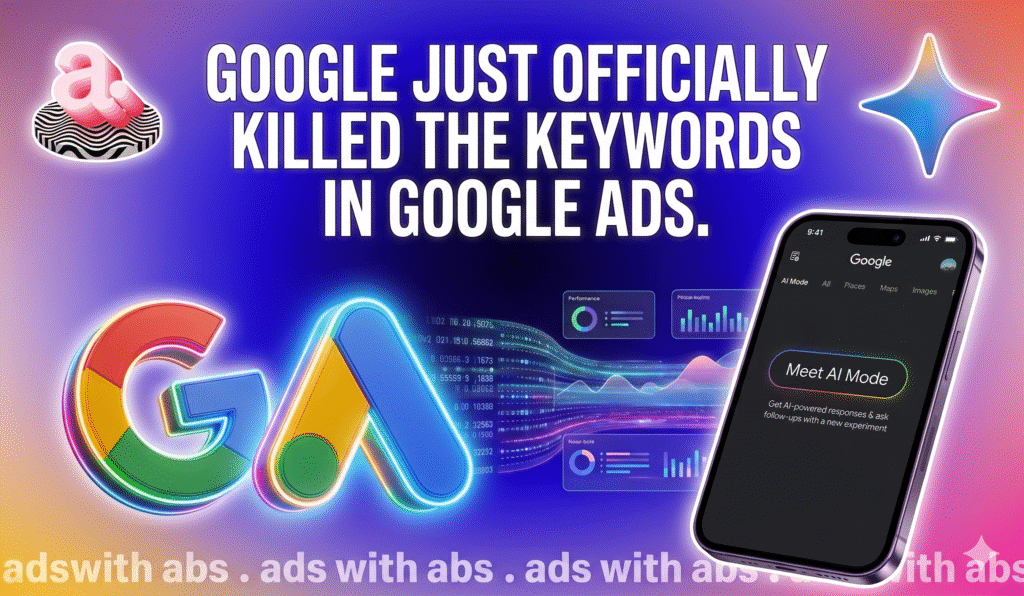
With Google rolling out its conversational “AI Mode” across the default search engine layout for over a billion users globally, they have officially pulled the plug. Search has evolved from explicit text matching to semantic intent vectors.
If you are still buying individual keywords inside Google Ads, you are buying ghosts. Here is what is actually replacing them, and how you have to structure your business to survive.
Understanding the architectural shift to “AI Mode”
When a modern user interacts with Google’s new AI Mode, they don’t type fragmented phrases like b2b home care platform pricing. They talk to Gemini exactly like a human operations director: “Hey, I manage a multi-regional home care agency with 60 field nurses. I need a compliant software setup that automates scheduling but links natively into our custom billing API. What are my top options, and what do their startup tiers cost?”
There is no legacy keyword list on earth that can map to that level of multi-turn, contextual nuance.
[Old Search Flow]: User Keyword -> Explicit Text Match -> Rigid Headline -> Static Landing Page
[New AI Mode Flow]: Conversational Context -> Intent Vector Mapping -> Gemini Dynamic Synthesis
In AI Mode, Gemini bypasses your explicit keyword lists entirely. The algorithm analyzes the entire context of the conversation, maps the user’s underlying business pain point, and dynamically pulls your data assets to formulate an answer. According to the format specifications in the Official Google AI Mode Documentation, ads are now directly generated as tailored components of the AI’s core conversation loop.
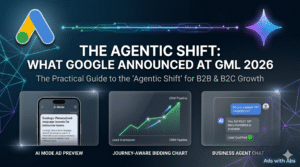
This isn’t an isolated update, either. If you want to see how this fits into the broader ecosystem Google just deployed—including the forced migration to the Universal Commerce Protocol and AI Max for Shopping—make sure to bookmark our comprehensive breakdown of everything Google announced at GML 2026.
You are no longer bidding on words; you are bidding on the semantic alignment of your entire brand ecosystem to a complex human problem.
The Rise of Headline-less “Conversational Ads for AI”
Let’s dissect what these ads actually look like on a screen, because the traditional anatomy of a Google Ad has been completely dismantled.
If you analyzed the official GML live demos closely—specifically the global rollout of Highlighted Answers featuring brands like Duolingo—you noticed something revolutionary. The static, decades-old format of “Headline 1 | Headline 2 | Description” is gone.
Instead, we are seeing the dawn of true Conversational Ads for AI.
These new ad formats do not use a catchy, forced title to bait a click. Instead, Gemini generates a long, deeply contextual description block that writes your product directly into the AI’s natural response. Injected natively right inside that conversational text block are direct action assets: deep-linked service pages, promotional codes, and specific pricing buckets (e.g., Startup, Growing, or Enterprise tracks).
It acts as a live, interactive recommendation card built inside the AI’s reasoning stream. It behaves completely differently from a standard Shopping ad or a classic text ad because it is optimized entirely for chat interfaces.
This structural evolution completely changes the game for media buyers, but it presents an even crazier crisis for organic traffic. If the AI is synthesizing the answer and embedding the ad natively, what happens to traditional clicks? I took a deep dive into the collateral damage of this shift in my recent guide on why SEO is dead for real this time, where we broke down how the agentic web is forcing brands to pivot from keyword optimization to Generative Engine Optimization (GEO).
💡 The B2B Cheat Sheet From the Trenches
I recently had a direct strategy session with a Google representative regarding the underlying technical framework for ranking inside these new conversational blocks. The advice was blunt: Your website footprint must be as conversational as possible. If you are in the B2B space, you need to aggressively deploy highly structured, natural-language FAQs across your service pages immediately.
When Gemini crawls your domain to validate your business for a Highlighted Answer, it isn’t measuring keyword density or looking for old-school SEO tags. It is looking for clean, conversational question-and-answer blocks that match the exact syntactic structure of how human beings talk to chatbots. If the machine can’t easily parse your solution in a natural sentence, you won’t get recommended.
The 2026 Playbook: How to build an “Agent Architecture”
To stop your digital campaigns from becoming entirely invisible on the modern SERP, you must stop managing accounts like a traditional media buyer and start acting like an Agent Architect. You control the inputs; the AI controls the matching.
- Consolidate into Intent Clusters: Collapse fragmented keyword ad groups into broad, thematic intent hubs. Use Google’s newly expanded AI Brief tools to give the algorithm plain-language guardrails regarding your brand voice and audience parameters, then let AI Max execute the conversational variations.
- Optimize for the Universal Commerce Protocol (UCP): Ensure your backend data feeds, product attributes, and text landing pages are written in human, descriptive terms rather than stuffed with rigid industry jargon.
- Secure Unfair Data Streams: Since the algorithm fully dictates the final ad matching, your only real competitive advantage is the quality of data you use to train it. Double down on deep first-party data integrations, hyper-accurate GA4 tracking, and offline conversion tracking via the Data Manager API.
The keyword era was a great run, but the machine has outgrown it. The future belongs to the brands that know how to structure their data to talk to the AI that talks to the customer.