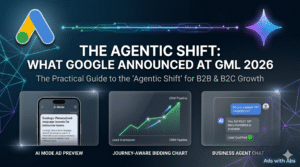

If you were tuned into Google Marketing Live (GML) 2026 on May 20, you probably felt the collective panic rippling through the PPC industry. While Google spent a significant chunk of time flexing new YouTube creator ad integrations, the absolute seismic shift happened when they detailed how Conversational Ads are officially rewriting the rules inside the brand-new AI Search Mode. When Google dropped this massive wave of updates, which you can track line-by-line via our comprehensive review detailing everything what Google announced at GML 2026, the real, landscape-altering earthquake happened quietly behind the curtain.
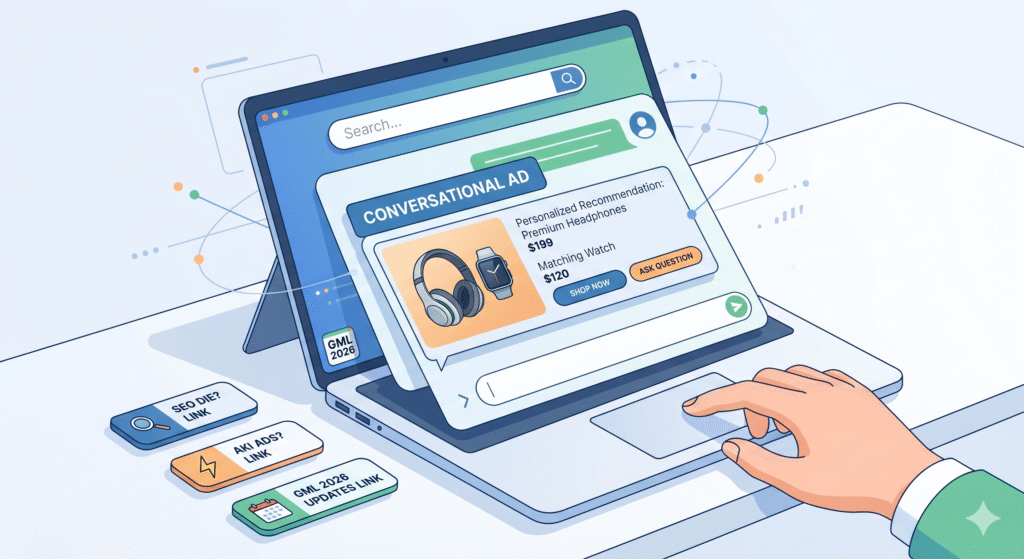
The era of typing static, fragmented phrases into a blank box and hoping for ten blue links is dead. Google’s AI Mode is completely shifting search from an index of destinations to a single, synthesized engine of answers. Google won’t be showing those 100,000 chaotic results anymore; its AI will serve the top 10 synthesized answers based on your exact search intent. Because the algorithm continuously tracks your ecosystem history across YouTube, Gmail, and active profiles, it already understands your underlying intent before you even finish interacting with the chat interface.
[AEO Direct Answer Snapshot]
What are Google Conversational Ads?
Google Conversational Ads are dynamic, interactive paid placements deployed natively within Google’s AI Search Mode. Moving away from traditional keyword-bidding models, these ads utilize Gemini-driven machine learning to parse long-tail user dialogue, serving hyper-personalized product recommendations and custom marketing copy directly mid-conversation.
Did GML 2026 just kill the traditional keyword?
For more than two decades, the foundational bargain of the internet has been simple: a human types a keyword, and an advertiser pays to intercept them. But that bargain is wrapping up. With recent core updates shifting organic traffic permanently toward synthesized AI summaries, traditional search engine real estate is fundamentally transforming. We saw this coming months ago when we analyzed why SEO is dead for real due to generative synthesis, forcing the paid ad ecosystem to rapidly adapt to a post-index world.
But don’t get distracted—this blog isn’t about organic SEO strategy; it’s about the future of your paid Google Ads budget. Many enterprise paid media leaders have spent the last two years screaming that manual keyword targeting’s end is near. Google has spent a decade practically begging us to adopt Dynamic Search Ads, and their automated reps have tried to push me into it more times than I can count. I always resisted because a sharp human marketer with tight keyword control could still out-optimize a generalized machine.
But things are completely different now that we have a live AI Mode in Google Search. Thanks to models like OpenAI and Perplexity, Google has aggressively accelerated its own AI-first search results, turning the old game on its head. As we noted when analyzing if Google just officially killed the keywords in Google ads, the algorithmic engine is moving from a syntax matching model to a pure reasoning model, meaning the battle is now about bidding your way into the AI’s personalized answer stream.
To reinforce this, Google’s Chief Business Officer, Philipp Schindler, looked right at global advertisers during the keynote and stated: “Google search is AI search through and through… Longer and more conversational searches mean richer signals of intent for us to better match what you offer with what people are looking for. You can’t think in terms of simple keywords anymore.”
What’s Next: The Rise of Standalone Conversational Campaigns (My 2028-2029 Prediction)
During GML 2026, Google made it clear they are currently pushing these conversational features through AI Max and Performance Max (P-Max) campaigns. Right now, we simply tell the ad network what we are selling, drop our product URLs, and let the algorithm stitch the assets together. If you log into your dashboard today, you’ll find these conversational features buried as new settings or minor extension options within your asset groups.
But we know Google never stops at just basic extensions.
Here is my prediction:
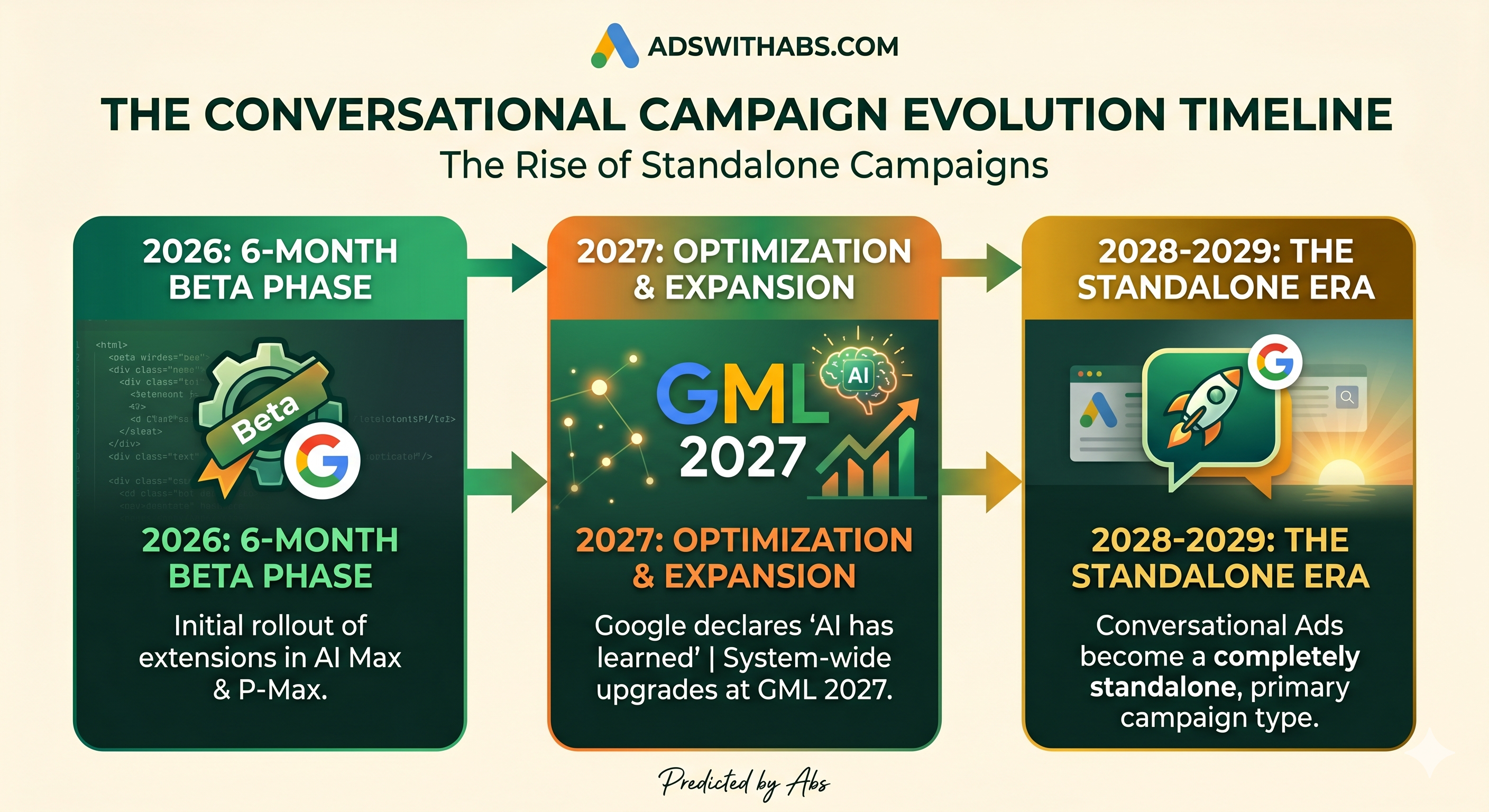
We are currently navigating the initial 6-month global beta phase. By GML 2027, Google will stand on stage and declare that “the AI has learned,” rolling out system-wide upgrades to conversational accuracy.
But by 2028 or 2029, the behavioral shift among users will be absolute. Because the broader public will rely entirely on interactive AI search results, Google will launch Conversational Ads as a completely standalone campaign type. It will step out from the shadow of P-Max and become the primary ad format on earth, completely replacing classic keyword search ads by 2030. Traditional text ads will only exist as a legacy fallback for users who manually opt out of AI Mode to hunt through old-school results pages.
Why did my new AI Max campaign burn $450 in a single week?
I burnt $450 on a single campaign, so you won’t have to. Here is my learning…
Let’s talk about real-world skin in the game. When AI Max first dropped, I didn’t want to just read Google’s polished documentation—I wanted to test how the engine maps abstract user intent when given completely unguided landing page data. I launched a campaign, targeted what I thought was a highly focused market, and let the algorithm run. It blew through $450 in exactly seven days.
If you want to uncover the high-ROI playbooks of tomorrow, you have to be willing to take risks, spend capital, and look at the raw data. What I bought with that $450 was a massive lesson in algorithmic semantic fracturing. Because an AI engine thinks in expansive, conceptual webs rather than literal word-matching, it completely misinterpreted my ideal customer profile. It wasn’t finding my buyers; it was mapping my ads to the customers of my customers.
Look at how easily a modern AI engine can cross wires if your landing page assets aren’t tightly structured:
| What My Campaign Targeted DOCX | How the AI Conceptualized the Intent DOCX | The Irrelevant Traffic Match DOCX |
| Premium AMOLED TV | High-definition digital display hardware | People searching for cheap, secondary closed-circuit CCTV security monitors |
| Curved Desktop Gaming Display | Multi-window desktop workspace systems | Corporate procurement managers trying to order bulk standard office monitors |
The user search might start with something as simple as wanting to buy a new TV, but the AI instantly maps that journey down a spiderweb of lateral intents – from gaming monitors to security displays. As Google’s Vice President and GM of Ads & Commerce, Vidhya Srinivasan, perfectly summarized: “We are not just bringing ads to AI search experiences, we are reinventing what an ad is.”
The moment I saw the algorithm bleeding budget into those lateral, completely useless search loops, I didn’t panic and pull the plug – I adapted. I immediately pivoted the bidding strategy to Max Conversions.
By changing the goalpost from broad contextual exploration to a strict, value-driven conversion anchor, I put a definitive leash on the algorithm. Max Conversions stopped the AI from wandering into loosely related conceptual spaces and forced it to find users executing our exact high-intent conversion actions. It instantly stabilized the data stream and saved the remaining budget.
How do you optimize a website for conversational AI ads?
If your current landing page strategy consists of stuffing high-volume search phrases into your H1s and hoping your Quality Score saves you, you are completely unprepared for the AI Mode era. It is now the marketer’s job to explicitly define exactly what they are selling down to the raw material and intent framework.
To make sure your brand is the one the AI engine cites, you need to implement this new optimization playbook:
- Establish Granular Product Attributes: AI doesn’t care about your clever marketing slogans; it cares about absolute specifications. Clearly define the exact technical architecture of what you sell (OLED, AMOLED, Curved AMOLED) directly in your copy and structured data so the engine can parse it instantly.
- Build Out Lateral Intent Exclusions: You need to explicitly tell the AI what you are not. If you sell premium consumer tech, explicitly state within your copy and backend metadata that your product is not intended for commercial B2B setups or security hardware networks to avoid accidental algorithmic matching.
- Deploy Dialogue-Based Q&A Schema: Build landing page blocks that mimic human conversation. Anticipate the complex, multi-layered follow-up questions a consumer will ask an AI assistant, and provide clear, direct, single-sentence answers that the model can clip and paste into the chat interface
Frequently Asked Questions:
How do I target ads in Google Search AI Mode?
Instead of uploading a list of keyword strings, targeting in AI Mode requires feeding high-quality product briefs, explicit asset parameters, and robust landing page copy into AI Max and Performance Max campaigns. Google’s Gemini engine dynamically matches your assets to long-tail, conversational user queries.
What is the difference between Google P-Max and AI Max campaigns?
Performance Max (P-Max) campaigns focus on automated asset cross-channel distribution across Search, YouTube, and Display. AI Max campaigns are designed specifically to deploy native, text-based and interactive conversational answers within the synthesized layout of Google’s new search AI Mode.
Will manual keywords completely stop working by 2030?
Yes. Based on platform trajectories from Google Marketing Live 2026, user search behavior is shifting entirely from keyword syntax to interactive chat dialogue. By 2030 (my prediction), traditional keyword-driven text ads are highly predicted to become legacy options, replaced by standalone Conversational Campaigns.
Why does AI Max drive irrelevant search traffic to my landing page?
Because AI models interpret data conceptually rather than literally. If your landing page copy relies on broad terms, the AI brain may map your product to a completely different user ecosystem (such as matching a high-end display TV with a customer looking for standard office monitors).
How do I stop an AI Max campaign from wasting my ad budget?
You must immediately anchor the algorithm by switching your bidding strategy to Max Conversions. This forces the machine learning model to stop exploring broad, lateral conceptual paths and strictly limits ad delivery to audiences whose profiles closely match your specific conversion actions