
The era of “targeting” is over. We have entered the era of “Retrieval.”
If you have been tracking the Meta Engineering logs since late 2025, you know that what the industry calls the “Andromeda Update” isn’t just a patch—it is the culmination of a three-year project to rebuild Meta’s ad infrastructure from the ground up.
For the last decade, we played a game of Probability: “What are the odds User X clicks Ad Y?” As of January 2026, we are playing a game of Semantic Retrieval: “Which ad creative contains the semantic signals that match User X’s latent intent?”
This guide is not about “hacks.” It is a technical breakdown of the three systems—GEM, Lattice, and Andromeda—that now control your money.
The Architecture of “Andromeda” (It’s Not Just One Thing)
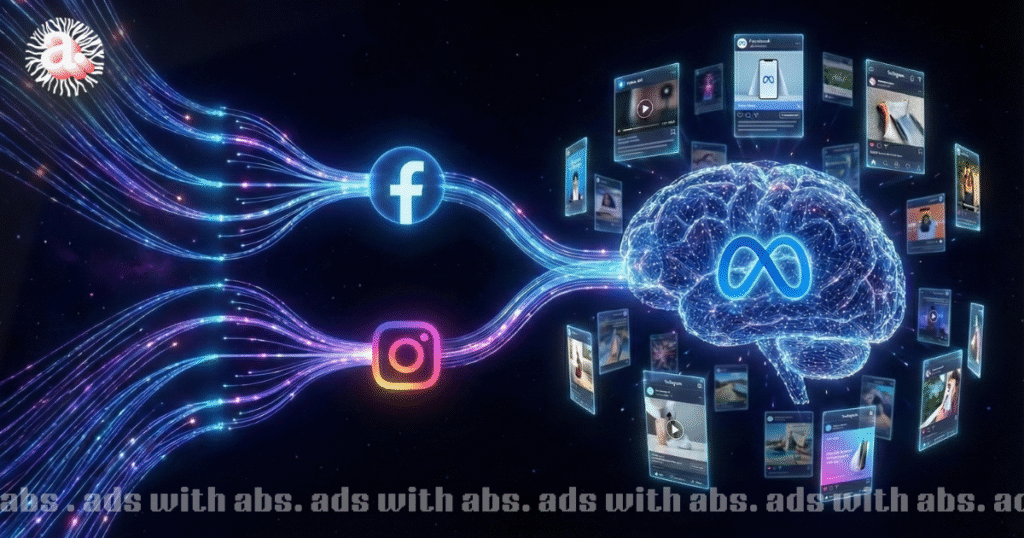
To understand why your manual audiences stopped working, you have to understand the machine that replaced them. “Andromeda” is the user-facing name for a complex stack of AI models.
Think of it like a biological system:
- GEM (Generative Ads Model) is the Brain. It understands the content.
- Meta Lattice is the Central Nervous System. It connects billions of data points across Instagram, Facebook, and WhatsApp into a single prediction map.
- Andromeda is the Hand. It is the retrieval layer that actually reaches into the database and pulls out the ad.
Let’s break them down, specifically focusing on the engineering marvel that is GEM.
Also Read: SEO is Dead in 2026 (For Real This Time)
Deep Dive: GEM (The Generative Ads Model)
The “Brain” that reads your ads.
You asked how it works. Let’s get technical.
Released in November 2025, GEM represents a fundamental shift in how ads are ranked. Previously, Meta used “Discrete Recommendation Models” (DRMs). These were great at handling sparse data (like clicks) but terrible at understanding context. They saw “Image #12345” got a click, but they didn’t know what Image #12345 actually was.
GEM changes that. It is a multimodal foundation model, trained on the same scale as Large Language Models (LLMs) like Llama 4 or GPT-5.
How GEM Was Trained (The Engineering Feat)
According to Meta’s engineering papers, GEM wasn’t just trained on clicks. It was trained on interconnected sequences.
- Infrastructure: It runs on thousands of H100s and Meta’s proprietary MTIA chips, utilizing a technique called Hybrid Sharded Distributed Parallel (HSDP). This allows the model to split “dense” parameters (visual data) and “sparse” parameters (user ID embeddings) across different GPU clusters, increasing training efficiency by 23x compared to 2024 models.
- The Dataset: It ingested billions of user-ad interactions, plus the semantic content of the ads themselves. It “watched” every video and “read” every image text overlay.
- Knowledge Distillation: This is the secret sauce. GEM is too big to run in real-time for every single auction. So, it uses a “Teacher-Student” architecture. The massive GEM model learns the patterns, then “distills” that knowledge into smaller, lighter models that run on your phone in milliseconds.
What GEM Actually Does
It assigns a Semantic Embedding to your creative. If you upload a video of a woman drinking matcha tea to focus on work:
- Old Algo: Saw “Video ID: 998877” + “Interest: Tea.”
- GEM: Sees “Visuals: Green liquid, Desk setup, Laptop” + “Audio: ‘Focus’, ‘Energy'” + “Context: Productivity.”
It then matches this Semantic Embedding with a User’s Intent Embedding. If a user has been watching productivity hacks on Reels (even if they never searched for tea), GEM makes the connection. The creative itself is the targeting criteria.
Deep Dive: Meta Lattice (The Prediction Map)
The “Nervous System” that predicts the future.
While GEM understands the content, Lattice understands the consequence.
Before Lattice, Meta had separate models for everything. One model predicted clicks for Reels, another predicted purchases for Feed, another predicted leads for Stories. This created “Signal Fragmentation.”
Lattice consolidates this into a unified “Multi-Token Prediction” architecture. Imagine a massive graph where every user action is a node. Lattice doesn’t just predict the next click; it predicts the entire sequence of future actions.
- The “Long-Horizon” View: Lattice is trained to optimize for long-term value (LTV), not just immediate clicks. It might show an ad to a user today knowing they won’t buy until next Tuesday, because it recognizes their “Consideration Sequence” pattern.
- Why Manual Targeting Breaks Lattice: When you force an audience (e.g., “Exclude 30-day visitors”), you are putting a wall in the middle of the Lattice graph. You are blinding the model to connections it has already found. This is why “Broad” targeting is non-negotiable—it gives Lattice the full map.
Also Read : Marketing in 2026: The Age of Agentic AI
Enter Andromeda: The Retrieval Engine
The “Hand” that picks the winner.
This is the update that went live globally in January 2026, causing the volatility you are seeing now.
In the old days, the ad auction was a funnel:
- Targeting: You select 1 million people.
- Filtering: Meta removes invalid users.
- Ranking: The remaining 10,000 are scored.
Andromeda changes this to a “Retrieval” process. Because GEM and Lattice are so smart, they can scan the entire user base of 3 billion people instantly. Andromeda doesn’t start with your audience size; it starts with your Creative Signal.
It asks: “Which users in the global database have an Intent Embedding that matches this ad’s Semantic Embedding?”
If your creative is generic (e.g., a “Buy Now” graphic), the Semantic Embedding is weak. Andromeda can’t find a match, so it “retrieves” low-quality bots or accidental clickers. If your creative is specific (e.g., “A guide for exhausted Moms”), the Semantic Embedding is strong. Andromeda retrieves “Exhausted Moms,” regardless of their age or location settings.
The Timeline: How We Got Here
- November 2023 – The Concept: Meta realizes post-iOS14 that pixel data is never coming back. They decide to move from “tracking” to “predicting.”
- May 2024 – Lattice Alpha: The unified model structure is tested on Instagram Reels. Engagement spikes by 20%.
- November 2025 – GEM Unveiled: Meta Engineering publishes the “Generative Ads Model” whitepaper, revealing the LLM-based architecture.
- December 2025 – The “Great Volatility”: Andromeda enters final beta. Advertisers report wildly fluctuating CPMs as the system re-indexes creatives.
- January 9, 2026 – Global Rollout: The “Ad Set” logic is officially deprecated in favor of Retrieval logic.
The Future: Meta Marketing in 2026 & Beyond
Based on the trajectory of GEM and Lattice, here is what is coming next.
1. The “Goal-Only” Interface (Projected Q3 2026)
We are moving toward an interface where you won’t even see “Campaigns” or “Ad Sets.” You will log in, provide a URL and a Business Goal (e.g., “Get leads for under $20”). Meta’s AI will:
- Scrape your landing page.
- Use GEM to generate the ad copy and image variations.
- Use Andromeda to find the users.
- Use Lattice to bid dynamically. Human Role: We become “Prompt Engineers” for the brand strategy, ensuring the website provides the right source material.
2. Synthetic User Testing (The “Sim” Sandbox)
Meta is developing “Synthetic Personas” based on Lattice data. Before spending a dollar, you will be able to run your ad in a simulation. The AI will tell you: “This ad will annoy Gen Z but convert Boomers.” This will kill the concept of “Testing Budget”—we will test virtually.
3. Video-to-Video Generation (Real-Time Personalization)
By late 2026, GEM will be able to alter video content in real-time.
- User A (Loves minimalist design): Sees your product video with a clean, white background.
- User B (Loves high energy): Sees the same product video, but GEM has swapped the background for a vibrant, fast-moving city scene. The “creative” becomes fluid.
The Strategic Pivot: How to Win Now
So, how do we survive the Andromeda update? We stop acting like media buyers and start acting like Signal Architects.
1. Semantic Density Optimization Your creative must be “machine-readable.”
- Visual Clarity: Ensure the product and the user avatar are clearly visible in the first 3 seconds. GEM needs to “see” who this is for.
- Audio Keywords: Use voiceovers that contain the exact keywords your audience searches for. GEM transcribes and indexes audio as a targeting signal.
2. The “3-Angle” Broad Stack Since Andromeda retrieves based on creative, you need to cast three distinct nets in a Broad campaign:
- Net 1 (Problem/Agitation): Retrieves users currently experiencing pain (High intent).
- Net 2 (Desire/Lifestyle): Retrieves users who want the result (Mid intent).
- Net 3 (Logic/Offer): Retrieves users waiting for a deal (Low intent). Running these together gives Lattice the data diversity it needs to stabilize performance.
3. Landing Page “Consensus” Andromeda verifies your ad’s promise against your landing page’s reality. If you promise “AI Software” but your LP looks like a generic agency site, the “Relevance Signal” breaks. Your Landing Page must semantically mirror your best-performing creative.
Final Thought: The “Andromeda” update is not a penalty; it is a filter. It filters out the advertisers who rely on tricks and rewards the advertisers who build genuine resonance. The machine is now smart enough to know if your marketing is good.
So… is your marketing good enough for GEM to understand it?