
If you are reading this, take a deep breath. You made it. You survived the chaotic, transformative, and frankly exhausting year that was 2025.
Welcome to the Year of “AI Action”
It is January 4, 2026. The confetti has been swept away, the gym resolutions are likely already broken, and your marketing dashboard is staring back at you, waiting for instructions. But here is the cold, hard truth: If you plan to run your campaigns in 2026 the same way you did in 2025, you are already behind.
The digital landscape didn’t just shift last year; it completely reinvented itself. We moved from “Digital Marketing” to “Algorithmic Orchestration.” We stopped asking AI to write funny captions and started asking it to predict customer lifetime value. The tools we thought were “futuristic” in 2024—like text-to-video and autonomous agents—are now the bare minimum requirement for entry.
This guide is not a list of predictions. It is a Playbook. It is a survival manual for the modern marketer who wants to move beyond “surviving” and start dominating.
Grab a coffee. Let’s get to work.
The Hard Lessons We Learned in 2025
Looking back, 2025 was the year of “The Great Filter.” It separated the marketers who understood technology from those who were just pressing buttons. Here is what the data taught us:
1. The “Average” is Invisible In 2025, the volume of content on the internet exploded by 400% thanks to generative AI. This created a “noise floor” that was impossible to break through with mediocre content. We learned that “good enough” is now synonymous with “invisible.” If your content doesn’t have a unique point of view or proprietary data, the algorithms (Gemini, Andromeda, Copilot) simply filter it out as spam.
2. Privacy is Not a Setting, It’s a Wall We finally saw the total deprecation of third-party cookies. The “Signal Loss” was catastrophic for brands that relied on browser-based pixels. We learned—the hard way—that First-Party Data is the only asset you actually own. Brands that hadn’t set up Server-Side tracking (CAPI) saw their attribution models collapse overnight.
3. Search Intent Shifted from “Finding” to “Answering” The biggest lesson of 2025 was the death of the “Ten Blue Links.” With the maturity of Google’s AI Overviews and the rise of Perplexity, users stopped clicking through to websites for simple queries. We learned that traffic volume is a vanity metric. The new metric is “Share of Answer”—how often your brand is cited by the AI.
Where Most Marketers Struggled (The “Graveyard” of 2025)
If you found 2025 difficult, you weren’t alone. Even the big players stumbled.
- The “Creative Fatigue” Spiral: This was the #1 killer of ROAS last year. Algorithms now consume creative assets at a terrifying rate. Marketers who were used to testing 3 images a month found their costs skyrocketing. The struggle wasn’t “bidding”; the struggle was feeding the machine enough high-quality video variations.
- The AI “Gimmick” Trap: Many brands wasted Q1 and Q2 of 2025 chasing shiny objects. They built useless chatbots that hallucinated, or they posted uncanny-valley AI avatars that creeped out their audience. The struggle was distinguishing between “Cool Tech” and “Business Utility.”
The Major AI Trends for 2026
So, where are we going? 2026 is not about chatting with AI; it is about deploying AI.
1. “Agentic” Workflows (The Rise of the Auto-Marketer)
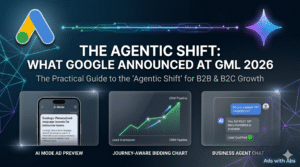
This is the buzzword of 2026: Agents. In 2025, you used ChatGPT to write an email. In 2026, you don’t use AI to talk; you use AI to do. We are seeing three specific “Agents” being deployed by top agencies right now:
- The Analyst Agent: Instead of you downloading a CSV, this agent connects to your Google Ads API, identifies keywords with high CPA but low conversion, and automatically pauses them while sending you a Slack notification.
- The Outreach Agent: It monitors LinkedIn for people asking about “marketing help,” scrapes their website to find their pain points, and drafts a personalized connection request for you to approve.
- The Creative Agent: It watches your Meta Ad Library. When an ad’s frequency hits 3.0, it automatically takes the original video file, generates a new hook using AI, and launches a new ad set.
The Reality: Marketing operations are moving from “Human-in-the-Loop” to “Human-on-the-Loop.” You are the supervisor, not the operator.
Also Read: Marketing in 2026: The Age of Agentic AI
2. Generative Engine Optimization (GEO)
SEO is evolving into GEO. We aren’t optimizing for keywords; we are optimizing for Information Gain. To rank in 2026, your content must provide new facts, unique data, or contrarian opinions that the AI hasn’t seen elsewhere. If you repeat what everyone else is saying, the AI summarizes them, not you.
Optimizing Your Channels (The 2026 Playbook)
Here is how to tune your engines for the specific algorithms ruling our lives this year.
1. Google Ads & Search (The Gemini Era)
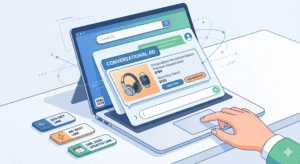
Google is no longer just a search engine; it is an Answer Engine, and the ad platform has evolved to match.
- The Update: “AI-Max” & The Death of Exact Match Google has fully rolled out AI-Max for Search. “Keywords” are now effectively just “Search Themes.”
- Exact Match is dead. Every keyword is now treated as Broad Match by the semantic engine. If you bid on “red shoes,” Google will show you for “maroon sneakers” if the intent matches. You can’t fight this; you have to guide it with negative keyword lists (which are now your primary control lever).
- The Creative: Demand Gen Auto-Trimming You no longer need to edit 6-second bumper ads manually. Google’s Demand Gen AI now takes your long-form YouTube video, identifies the most viral moments based on engagement signals, and auto-trims them into Shorts/Bumpers for you.
- The Tactic: GenAI Product Images Merchant Center Next now uses Google Imagen 3 to automatically fix your product photos. It can remove backgrounds or generate lifestyle scenes (e.g., placing your sunglasses on a beach towel) without a photoshoot.
2. Meta (Facebook & Instagram) – The “Andromeda” Algo
Meta is currently the king of ROI, but the rules have changed completely with the release of the Andromeda Update.
- The Update: “Engagement Velocity” The Andromeda Algorithm has shifted priority from “Clicks” to “Engagement Velocity.” It measures how quickly a user stops scrolling when your ad appears. If they pause for less than 0.5 seconds, your CPM doubles.
- The Optimization: The Retirement of Manual Targeting Rumors are confirmed: Meta is beta-testing the retirement of Manual Targeting for conversion campaigns in 2026. Advantage+ is becoming mandatory. The “Detailed Targeting” (Interests/Behaviors) options are being grayed out.
- The Strategy: Creative IS Targeting Since you can’t target “Dog Owners,” you must put a dog in the first second of your video. The algorithm reads the visual data of your video to decide who to show it to. If your creative is generic, your targeting will be generic.
3. Microsoft Ads & Bing (The Copilot Edge)
Do not sleep on Microsoft. With Copilot integrated into Windows 12, Bing’s B2B market share is hitting new highs.
- The Update: Deep Search Bing now conducts a “Deep Search” for complex queries.
- The Optimization: Target B2B decision-makers. Microsoft’s LinkedIn integration allows you to target users on Bing based on their Company Name and Job Title.
- The Tactic: Use “Multimedia Ads.” Microsoft loves visual search. If you aren’t using their Creator Tools to generate specific vertical assets, you are invisible on the Sidebar.
4. LinkedIn Ads (The Video Revolution)
LinkedIn in 2026 feels a lot like TikTok in 2022, but for people in suits.
- The Update: The feed is now video-dominant. The “Thought Leader Ad” format allows you to boost posts from your employees’ personal profiles.
- The Optimization: Human-to-Human (H2H). Company page posts are dead reach-wise. Run ads from your CEO’s profile or your Head of Sales’ profile.
Top Content Generation Tools for 2026
To execute the strategies above, you cannot rely on manual labor. You need the 2026 stack.
1. For Video: Sora (OpenAI) vs. Google Veo
- Sora: The cinematic king. Best for high-drama, TV-commercial quality shots.
- Google Veo: The commercial workhorse. Integrated directly into Google Workspace (Vids), it’s perfect for turning a Google Doc script into an explainer video with charts and stock footage in seconds.
2. For Images: Midjourney v7 vs. Google Imagen 3
- Midjourney v7: Still the best for “Vibe” and artistic concepts.
- Google Imagen 3: The best for Products. Use it inside Google Merchant Center to turn boring white-background product shots into lifestyle images that match your brand guidelines perfectly.
3. For Copy & Strategy: Claude 3.5 (Agentic) vs. Gemini Advanced
- Claude 3.5: Best for writing “human-sounding” long-form blogs and emails.
- Gemini Advanced: The best for Research. Because it’s connected to Google Search live, use it to analyze your competitor’s PPC landing pages and spot gaps in their offer.
Conclusion: Adapt or Fade Away
2026 is not a year for the timid. The gap between the “AI-Native” marketers and the “Traditionalists” is widening into a canyon.
If you are still trying to optimize campaigns by manually tweaking keywords and obsessing over vanity metrics, 2026 will be a struggle. But if you embrace the Agentic Workflow, if you optimize for Answers instead of clicks, and if you lean into Video-First storytelling, this will be the most profitable year of your career.
The tools are here. The algorithms (Andromeda, Gemini, Copilot) are ready. The only variable left is you.
Are you going to let the AI replace you, or are you going to become its Director?
At AdsWithAbs, we know which side we are on. Let’s get to work.