
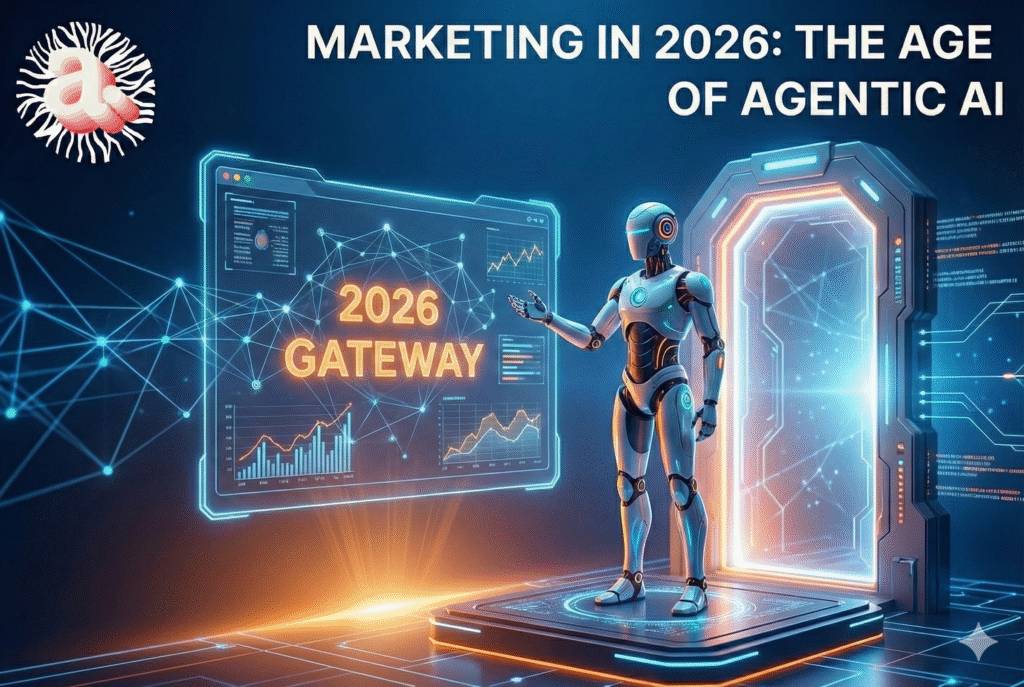
Scene 1: Imagine walking into a mega-store with 10,000 items on the shelves. But you can’t walk the aisles. A Robot Clerk stands at the door. You ask for “Cold Cream.” It doesn’t let you browse; it instantly hands you three options. You can’t see the other 9,997 products. They might be cheaper. They might be better. But to you, they don’t exist. You pick one, and before you can even reach for your wallet, the Robot has already charged your card and shipped it to your home. This is the new SEO.
Scene 2: You spill your morning coffee. A smart sensor detects the mess and deploys a cleaner bot. But here is the catch: The bot notices it’s running low on cleaning fluid. It doesn’t beep at you. It doesn’t ask for permission. It silently negotiates with three vendors online, finds the fastest shipping, and places the order itself. You didn’t buy that cleaning fluid. The machine did.
What is Agentic AI – A Brief Intro:
In Scene 1, I hope you remember the “Scary Robot Shopkeeper”, the one who always give 3 choices, also chooses by itself, and always packs and ships to your address. That’s Agentic AI.
Now in last 3 years we have been seeing the Generative AI on the roll. People have been writing poems, editing photos. Etc. Everyone weas happy. But as 2025 ended, we saw the rise of AI tools – Softwares who were able to do automate tasks, depending on a certain condition is met. Like the coffee machine who orders milk, when its low on milk.
So, an Agentic AI is one who not only will get the job down but can also suggest how to do that.
It’s Technical Shift: we started from LLM, now we are in LAM. Where LLM does the prediction for next word in the text, but also predicts what action should it take in the workflow.
So if we try to explain again with the example of Robotic Shopkeeper:
LLM – Generative AI: It’s the brochure of the request om the table. It does nothing.
LAM – Agentic AI: The Robotic-Shopkeeper, it has access to all the tools, the API. It has a goal (“Buy the cheapest flight”). And most importantly, it has autonomy.
Why AI is important in 2026:
Till 2025, we were making the website for humans, the Json scripts for webs crawlers. But now in 2026 we need to make the website more visible to Agentic AI. So if a customer asks to book a book a demo for a Meeting Booking solution. But if the Agentic-Ai cant find the Book Demo button, because it was hidden behind some other page. So making websites ready for LAM in now more important than ever.
What Actually Is Agentic AI? (Beyond the Buzzword)
If the phrase “Agentic AI” sounds like just another marketing buzzword to you, pay close attention. This isn’t a rebrand of ChatGPT. It is a fundamental shift in how software functions.
For the last three years, the world has been captivated by Generative AI (LLMs).
Generative AI is a Creator: You ask it to write an email, and it writes. You ask for a strategy, and it drafts a document. It is passive. It waits for you to prompt it, and it delivers text or images.
Agentic AI is a Doer: It doesn’t just “talk”—it acts.
The Technical Shift: From LLMs to LAMs We are transitioning from Large Language Models to Large Action Models (LAMs). While an LLM is trained to predict the next word in a sentence, a LAM is trained to predict the next action in a workflow.
Think of it this way:
Generative AI is a brochure on a counter. It contains all the information you need, but it sits there until you read it.
Agentic AI is the store manager. It has access to the cash register, the inventory system, and the phone line. It has a goal (e.g., “Restock the shelves”) and the autonomy to execute it without human hand-holding.
Why This Changes Everything in 2026 In 2025, marketers optimized websites for human readability. We focused on emotional hooks, color psychology, and persuasive copy. In 2026, we must optimize for machine navigability. If an Agent is tasked with buying your product or booking your service, it doesn’t care about your “brand story.” It cares about friction. If your checkout requires too many clicks, or your pricing is hidden, the Agent will abandon the task instantly.
Why a LAM Will Visit AdswithAbs (And Why It Might Leave)
You might be thinking, “I run a B2B Agency. I sell services, not cold cream. Why would a robot visit my site?”
Because your future clients are too busy to visit it themselves.
In the high-level B2B world, executives are beginning to delegate the tedious vendor-vetting process to AI agents. Imagine a Marketing Director at a mid-sized tech firm. She is overwhelmed. She opens her enterprise copilot and types:
“I need a digital agency that specializes in ‘Agentic SEO’ and ‘PPC Audits’ for e-commerce. Find me 3 viable options, check their availability for a consultation next week, and book a 30-minute intro with the best one.”
Here is exactly what the LAM does when it hits AdswithAbs.com:
A. The Capability Scan (The Vetting)
The Agent isn’t reading your blog for entertainment. It is scanning your Service Pages for specific Entities to verify you are qualified. It looks for hard data: Case studies, verified reviews, and specific service keywords (e.g., “PPC Audit,” “ROAS Optimization”).
The Risk: If your site relies on fluff (“We create digital magic”) rather than concrete signals (“We manage $5M in ad spend”), the Agent marks you as “Low Relevance” and moves to the next tab.
B. The Calendar Handshake (The Conversion)
The user’s prompt was specific: “Book a 30-minute intro.” The Agent navigates to your “Contact” page. It attempts to interact with your booking tool.
The Fail State: If your calendar is hidden behind a “Request a Quote” form that requires manual approval, the Agent stalls. It cannot complete the task.
The Win State: If you use an open API scheduler (like Calendly or HubSpot) that allows the bot to scan for free slots, the Agent cross-references its boss’s schedule and books the meeting automatically.
C. The Pricing Snipe (The Budget Filter)
Often, the user adds a constraint: “Only book if they are under $5k/month.” The Agent scans for pricing transparency.
The Strategy: In the Agentic Era, hiding pricing is a liability. You don’t need to list every penny, but providing a machine-readable ‘Starting At’ range (e.g., in your schema) allows the Agent to tick the “Budget Safe” box and proceed with the booking.
The Result: If you are optimized for Agentic AI, your notification bar doesn’t say “New Lead Form Submitted.” It says: “New Meeting Confirmed: Tuesday at 10 AM (via AI Agent).”
The “Agentic-Ready” Checklist (Send This to Your Dev)
To survive 2026, you need to stop optimizing for “Eyeballs” and start optimizing for “API Calls.” Here is the exact checklist your technical team needs to implement today.
✅ 1. Implement “Action Schema”
Standard Schema (JSON-LD) tells Google what your product is. “Action Schema” tells the AI what it can do with it.
The Fix: Add PotentialAction markup to your code.
Example: Instead of just listing a “Consultation,” mark it up with ReserveAction so the AI knows it can actually book it, not just read about it.
✅ 2. Ungate Your Critical Data
Marketing in 2024 was about “Lead Magnets” (hide info to get an email). Marketing in 2026 is about “Data Transparency” (show info to get the bot).
The Fix: Ensure your pricing tiers, return policies, and stock levels are visible in the HTML/DOM. If it’s locked inside a PDF or an image, to the AI, it doesn’t exist.
✅ 3. Verify Your Entity Authority
AI Agents operate on “Trust Graphs.” If Google’s Knowledge Graph doesn’t know who you are, the Agent won’t recommend you.
The Fix: Claim your Knowledge Panel. Ensure your “About Us” page links to verified profiles (LinkedIn, Crunchbase, G2). Create a “SameAs” schema loop that connects all your digital identities.
Conclusion: The Human Advantage
So, if the AI Agents are buying, selling, and researching… what is left for us?
Strategy.
The AI can optimize the bid, but it can’t understand why a customer feels insecure about their purchase. It can generate 50 ad creatives, but it can’t tell you which one has “soul.” It can book the meeting, but it can’t close the deal with a handshake.
2026 isn’t about competing with machines. It’s about building a brand so distinct and trusted that the machines have to recommend you. The Age of Agentic AI is here. The question isn’t “Will you use it?” The question is: “Is your business ready to be found by it?”

One thought on “Marketing in 2026: The Age of Agentic AI”